About the Eagle Lake corridor
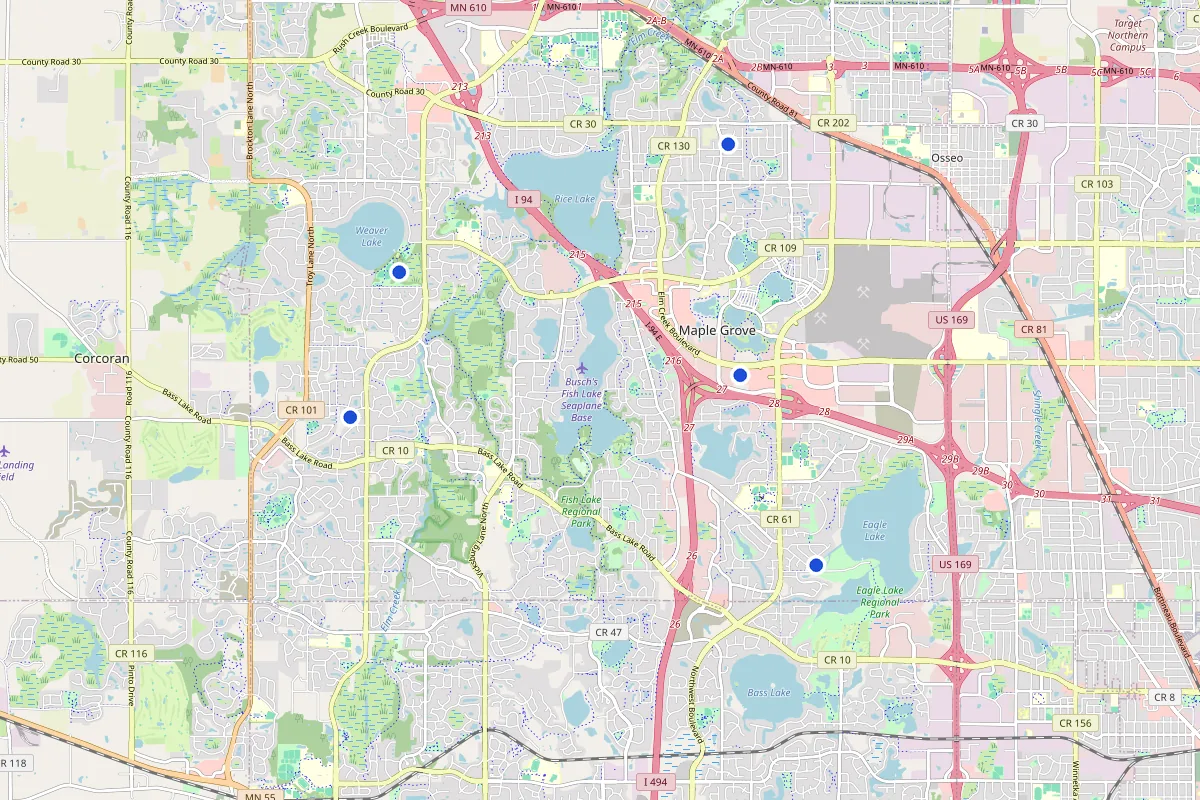
The Eagle Lake corridor sits along Maple Grove’s southeastern edge, wrapped around Eagle Lake itself and anchored by Eagle Lake Regional Park, which sits on the Plymouth and Maple Grove border (Three Rivers Park District). The corridor runs roughly along 93rd Avenue North, with residential streets feeding off both the park access roads and the golf-course frontage to the south. ZIP 55369 covers the full corridor.
Housing here is a mix of golf-course-adjacent custom homes, built mostly through the 1990s and 2000s along the Eagle Lake Youth Golf Center frontage, and family subdivisions from the 2000s and 2010s further north and east. Lot sizes vary: golf-course-facing lots tend toward larger envelopes with mature landscaping, while the subdivision sections off 93rd Avenue run closer to standard suburban dimensions. Average affluence skews mid-to-upper.
For backyard-court work, putting-green inquiries skew noticeably higher in Eagle Lake than in other Maple Grove corridors, because Eagle Lake Youth Golf Center is a short drive or walk for most addresses, and homeowners who play regularly often want a multi-hole synthetic putting green with chipping zones at home. Pickleball and multi-sport builds are also common, particularly on the larger golf-course-adjacent lots where setback math works in the homeowner’s favor.
Named landmarks in the coverage area
- Eagle Lake Regional Park (on the Plymouth and Maple Grove border, with a carry-in canoe and kayak launch, an accessible fishing pier and trails, per Three Rivers Park District)
- Eagle Lake Youth Golf Center (a nine-hole par-31 course and a nine-hole par-27 pitch-and-putt, along the corridor’s southern edge)
- Eagle Lake itself (the corridor’s namesake water feature)
- 93rd Avenue North (primary east-west corridor through the residential section)
- Three Rivers Park District trail connections (regional trail system links through Eagle Lake Park)
- Pike Lake Road (eastern corridor edge, connects toward the Bass Lake / Plymouth border)
If you’re inside the corridor bounded roughly by these landmarks, you’re in our normal Eagle Lake service area.
Eagle Lake area: common questions
Do many Eagle Lake homeowners pair pickleball with a putting green? Yes. Pickleball and putting greens are a natural pairing in the corridor. Eagle Lake Youth Golf Center proximity drives the putting-green demand, and pickleball pairs well with it on lots that have room for both a 30-by-60-ft court envelope and a separate 400 to 800 sq ft green. A combined site plan can be sketched at the survey stage if you want to phase the build across two seasons.
How do golf-course-adjacent lots affect putting-green design? Golf-course frontage usually means more usable backyard depth, fewer neighbor sightlines on the course-facing side, and existing grade work that’s already drainage-friendly. Multi-hole layouts (3 to 6 holes) with fringe collars and chipping zones are realistic on most of these lots. The site survey measures actual slope and turf-edge transitions. The goal is a green that reads naturally against the adjacent course landscape rather than a flat synthetic pad.
Any specific setbacks near the regional park? Setbacks on a private lot here come from the City’s zoning code and from your subdivision’s own rules, and we don’t pull permits, so what the code requires for your parcel, and whether backing onto the regional park changes anything for it, are questions the City answers rather than us. You may have run into a 200-ft figure attached to pickleball courts around here. That one is a City Parks and Recreation Board policy about how far the City keeps courts in its own parks from residential structures, not a rule on your lot (Request for Board Action). What the site survey maps is the actual distance from the court to the nearest neighboring structures, along with the build envelope, before any quote.
Eagle Lake facts that bear on a backyard build
The lake answers to a different watershed commission than Weaver Lake does. Eagle Lake covers about 291 acres and falls under the Shingle Creek Watershed Management Commission, according to its Metropolitan Council monitoring record (EIMS, Eagle Lake - Maple Grove). Weaver Lake reports to the Elm Creek Watershed Management Commission instead (EIMS, Weaver Lake). Rain that runs off a new court slab joins that local drainage system, so where the court sheds its water is worth settling on the site plan.
Lots near the lake may sit inside the state shoreland district. Minnesota defines shoreland as land within 1,000 feet of the ordinary high water level of a public lake (Minn. R. 6120.2500, subp. 15). The statewide minimum standards that a city’s shoreland ordinance is written against cap impervious surface on a shoreland lot at 25 percent of lot area (Minn. R. 6120.3300). A 30 by 60 ft pickleball slab is 1,800 sq ft of impervious surface on its own. Whether your parcel is in the City’s shoreland overlay, and which cap governs it, is a question for the City of Maple Grove with your address.
The golf next door is a real course, not a single green. The Eagle Lake Youth Golf Center inside the 230-acre Eagle Lake Regional Park, on the Plymouth and Maple Grove border, runs a nine-hole par-31 course, a nine-hole par-27 pitch-and-putt course and a 40-station lighted practice range (Three Rivers Park District). With full-length practice that close, a backyard green here can be planned around putting and short chipping, leaving full swings to the range.
Sources read 2026-10-10.
Services covered in the Eagle Lake area
- Putting green installation: synthetic multi-hole greens, fringe collars, chipping zones. Eagle Lake’s lead service given golf-course proximity.
- Pickleball court installation: backyard pickleball court design and install: acrylic surfacing, fencing, nets, lighting.
- Multi-sport court installation: combined pickleball / basketball / tennis / volleyball / futsal surfaces.
- Backyard basketball court: half-court and full-court installs with concrete pad, acrylic surfacing, in-ground hoops, court-line painting.
- Batting cage installation: netting structures, turf flooring, pitching mounds.