Multi-sport court installation in Maple Grove, MN puts one backyard surface, striped and equipped, in play for two, three, or four sports, serving homeowners across Maple Grove and the northwest Twin Cities metro in Minnesota. Planning a multi-sport court in Minnesota means designing around frost depth and a short build window, and this page covers the sport-mix and sizing decisions, the acrylic-vs-tile surface choice, Maple Grove HOA review, and the April-through-October Minnesota install season.
What multi-sport court installation in Maple Grove, Minnesota typically looks like
A multi-sport court is the right call when one sport isn’t enough — basketball and pickleball, pickleball and volleyball, or a futsal pad that also stripes for badminton and dek hockey. The most common builds pair basketball with pickleball, or run a three-sport layout for pickleball, volleyball, and badminton.
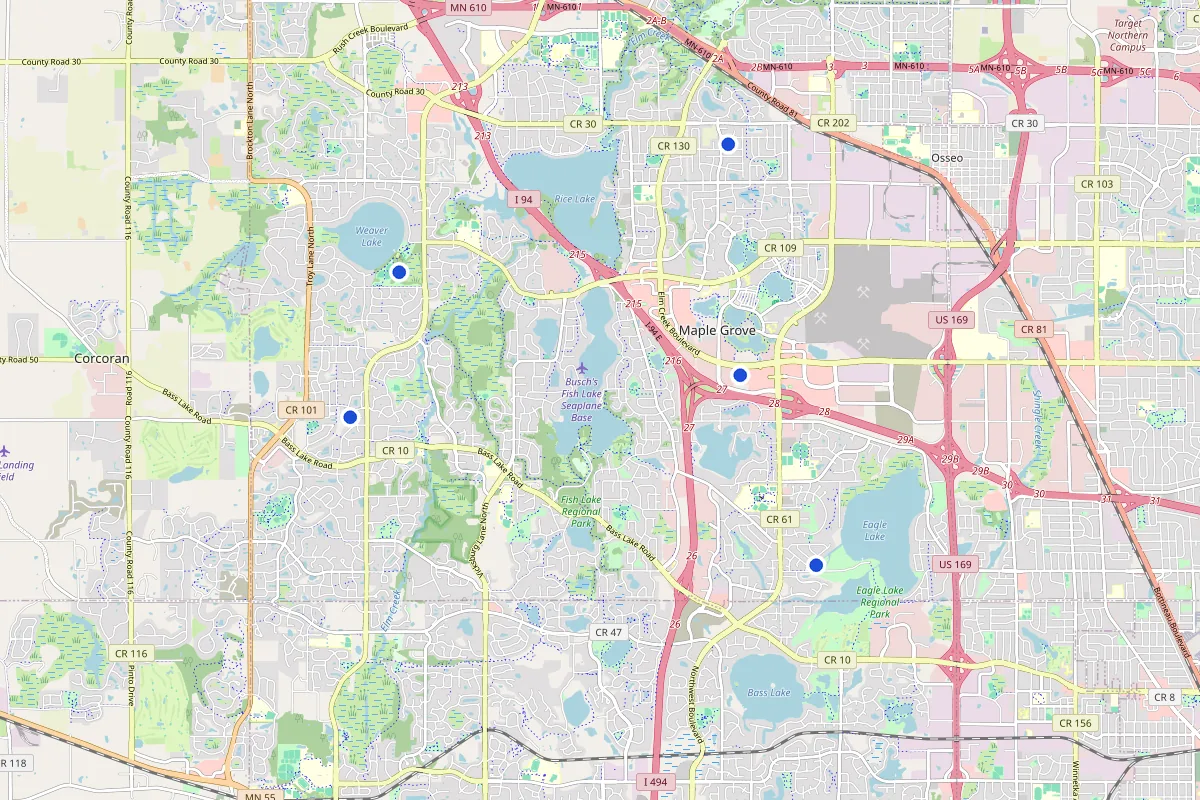
This site covers both Maple Grove ZIPs, 55311 and 55369, from Arbor Lakes and Rush Creek through the lake-adjacent properties near Weaver Lake and Eagle Lake to the corridors off Elm Creek Boulevard. Typical footprint runs 30×60 ft to 50×100 ft depending on the sport mix. A basketball half-court with pickleball lines sits at the lower end; a tennis-scale build with pickleball, volleyball, and futsal striping needs the upper end. Which end of that range fits depends on how much of your lot is left after setbacks.
Maple Grove’s multi-sport facilities
The multi-sport idea isn’t new to Maple Grove — the city already builds courts this way. Gleason Fields packs a basketball court, a tennis court, and pickleball courts onto one complex beside its turf ball fields, and Central Park runs a shared basketball-and-pickleball sport court (per the City of Maple Grove parks pages). A backyard multi-sport court is that same “more than one game on one surface” logic, sized for a private yard — which is why basketball-plus-pickleball is the most-requested layout.
What’s included
- On-site survey — measure the build envelope, check slope and drainage, flag setback or HOA constraints
- Written, dimensioned site plan with court size, sport mix, and line layouts
- HOA approval package — dimension drawings, materials spec, noise-mitigation docs
- Base preparation — excavation, leveling, drainage, concrete pad or aggregate sub-base
- Surface system — acrylic hard-court coatings or modular interlocking tile (homeowner choice)
- Multi-line striping for every sport in the mix
- Fencing — chain-link, mesh, or low-profile rebound systems
- Optional LED court lighting
- Hoops, nets, and posts — basketball goal system and net posts as required
- Final walkthrough + surface care guide
How pricing works
A smaller acrylic build with a two-sport overlay is a much simpler job than a modular-tile court carrying three or four sports plus fencing and lighting. We are not the installer and we don’t set the price — the installer quotes your build in writing after the site survey.
What moves the number:
- Court size. Base prep + surfacing scales with square footage; 30×60 ft is roughly half a 50×100 ft build.
- Surface system. Modular tile carries higher material cost than acrylic.
- Sport mix. Each added sport adds striping and sometimes net-post hardware. Basketball-plus-pickleball is the simplest two-sport overlay — shared paint lines and no net-post hardware beyond the pickleball posts.
- Fencing + access. Full chain-link costs more than rebound systems; tight-access yards add crew-hours.
Ask for the quote in writing and after the site survey. A round-number guess over the phone, before anyone has walked the lot, is not a quote.
Surface system: acrylic vs modular tile
The two main residential surfaces are acrylic hard-court (what most tennis and pickleball facilities use) and modular interlocking tile (snap-together polypropylene over a concrete base). Both work for the full sport mix.
| Factor | Acrylic hard-court | Modular interlocking tile |
|---|---|---|
| Material cost | Lower | Higher |
| All-season | Closes for MN winter; frost cycles eventually crack the surface | Engineered for freeze-thaw; year-round play when cleared |
| Repairability | Resurface every 5–8 years | Tiles snap out and replace in minutes |
| Look-and-feel | Classic court look; consistent texture | Slight tile-seam pattern; joint-friendly cushioning |
Acrylic wins when budget is the constraint and you play April through October. Modular tile wins when all-season play, joint-friendly cushioning, and per-tile repairability matter over the build’s lifetime.
Maple Grove HOA + setback considerations
Most Maple Grove subdivisions require architectural-review-board approval for backyard courts at this scale. Multi-sport builds trip the same review thresholds as dedicated pickleball — sometimes more, since the larger footprint and combined sound profile (basketball bounce + paddle pop + futsal kick) raises noise-mitigation concerns.
Sport mix is the thing that moves an architectural-review board, because it drives the sound profile. A dedicated pickleball court is the loudest of these surfaces, and a multi-sport court that carries pickleball striping alongside basketball is generally used differently — fewer hours of paddle play, spread across more sports. How your board weighs that is your board’s call, not a rule we can state for it. The site survey maps the envelope, measures the distance to the nearest neighboring structures, and shows you which layout that distance actually supports.
Boards commonly want a scaled layout, the surface and fencing materials, a sound-mitigation note, and the line layout. Your board will tell you what its packet requires, and the installer who takes the job prepares what they need for it. Most boards take 30–60 days.
Process + lead time
- Site survey. The survey measures the build envelope, checks slope and drainage, and flags setback / easement / HOA constraints before quoting.
- Written, dimensioned plan. Court layout, sport mix, surface system spec, and price — delivered after the survey, once measurements and site conditions are confirmed.
- HOA review. Your board sets its own submission requirements, and the installer who takes the job prepares what they need for it. Most boards take 30–60 days.
- Build kick-off. Excavation, base prep, surfacing, fencing, lighting, striping, hoops, nets — typically 3–5 weeks on site depending on size, surface, and weather. Acrylic needs a curing window between coats; modular tile installs faster once the base cures.
- Final walkthrough + care guide at handover.
End-to-end timeline from first call to first game is typically 2–4 months — driven by the HOA review window and Minnesota’s April-through-October install season. Projects booked November through March schedule for the next spring window.
The Maple Grove rules that size a multi-sport court
A multi-sport court is usually the largest footprint on this site, and the bigger the slab, the more of the city code it reaches. Three rules are worth reading before a layout is settled, because each one is cheaper to plan around than to discover.
The court counts toward a 40 percent impervious surface cap. Maple Grove City Code section 36-787 sets the maximum impervious surface for a lot in the R-1, R-2 and R-3 residential districts at 40 percent. The footprints on this page run from 30×60 ft, which is 1,800 sq ft, up to 50×100 ft, which is 5,000 sq ft, and that area is added to the house, the garage, the driveway and any patio already on the lot. Each sport added to the mix tends to push the footprint up, so choosing the sports is also an impervious surface decision. If a layout would take the lot over the cap, the usual answers are a smaller footprint, fewer sports, or a change somewhere else on the property. A bidder who measures your lot against the cap before quoting is doing the useful part of the survey. (Source: Maple Grove Code of Ordinances, Chapter 36 Zoning, section 36-787, read 2026-09-11.)
The code names tennis courts, and a multi-sport court is not on the list. Section 36-788(d) excludes a short list from the accessory-building definition: unenclosed playhouses and gazebos, uncovered swimming pools, detached decks or patios, and tennis courts. A court striped for basketball, pickleball and volleyball is not named. That does not make it an accessory building. It means the code does not say, and it matters because section 36-788(b) keeps accessory buildings out of any required yard other than the rear yard. Where a court of this size can sit on your parcel is a question for Maple Grove Community Development before the layout is drawn. (Source: Maple Grove Code of Ordinances, Chapter 36 Zoning, section 36-788, read 2026-09-11 for (d) and 2026-05-28 for (b).)
Perimeter fencing meets the 6 foot residential limit. If your layout includes fencing to keep balls on the court, its height is the number to check. The Maple Grove Building Department’s Fences handout, revision 4/14/2021, states that in residential areas fences no more than 6 feet in height may be erected, and that fences differing in height may be permitted by conditional use permit. When a bid shows a fence taller than 6 feet, ask whether it assumes a conditional use permit and who is responsible for filing it. (Source: City of Maple Grove Building Department, “Fences,” rev. 4/14/2021, read 2026-09-11.)
Sources: Maple Grove Code of Ordinances, Chapter 36 Zoning and the City of Maple Grove Building Department “Fences” handout, rev. 4/14/2021. How each rule applies to your specific parcel is a question for Maple Grove Community Development at 763-494-6040, and that call is yours to make rather than ours.
Common questions
Can one court really do basketball, pickleball, and volleyball? Yes — multi-line striping handles the sport mix, and net posts install as sleeves so volleyball and pickleball nets swap in and out. Basketball hoops are fixed. The main constraint is footprint: 30×60 ft covers basketball plus pickleball; adding volleyball or futsal pushes toward 40×80 ft or larger.
How much does lighting add to a multi-sport court build? Most Maple Grove HOAs require down-shielded fixtures to limit light spill — accounted for in the standard spec.
Is modular tile worth the upcharge for all-season play? Depends on use. If you’ll play year-round, modular tile’s freeze-thaw engineering and per-tile repairability earns the difference over the build’s lifetime. If you’ll close for winter, acrylic’s lower upfront cost is usually the better call.
Can a multi-sport court fit on a smaller backyard lot? A basketball-plus-pickleball overlay fits on 30×60 ft, which works for most Maple Grove in-town lots once setbacks are mapped. Three- or four-sport layouts need 40×80 ft or larger. The site survey confirms fit.
Are hoops, nets, and posts included? Yes — basketball goal system, pickleball / volleyball / tennis net posts, and the nets. Premium hardware (pro hoops, tournament-grade nets) is a quoted add-on.
How much does a multi-sport court cost in Maple Grove, MN? A two-sport acrylic overlay is the simplest build. The section above breaks down every cost driver.
Which sports can you stripe a Maple Grove multi-sport court for? Backyard courts across Maple Grove get built and lined for basketball, pickleball, tennis, volleyball, futsal, badminton, and dek hockey — any combination on a single surface. Basketball-plus-pickleball is the most-requested two-sport layout; pickleball, volleyball, and badminton is the most common three-sport build. Across Maple Grove ZIPs 55311 and 55369, the sport mix gets mapped to your footprint at the survey. When tennis is the primary game rather than one sport in the mix, a dedicated build is usually the better call — see our tennis court installation page.
Do you build multi-sport courts elsewhere in Minnesota? Our core service area is Maple Grove and the adjacent NW Twin Cities suburbs — Plymouth, Brooklyn Park, and Osseo. Coverage stretches farther into the Minnesota metro for larger builds; ask when you call and we’ll confirm whether your address is in range before a survey is scheduled.
Maple Grove neighborhoods covered
Multi-sport court projects are covered across every part of Maple Grove and into the adjacent NW-metro suburbs:
- Arbor Lakes — Main Street district, subdivisions east of I-94 (55369 + 55311)
- Weaver Lake — wooded subdivisions north of Bass Lake Road (55311)
- Eagle Lake — 93rd Avenue residential corridor (55369)
- Rush Creek — larger-lot subdivisions with room for full-footprint builds (55311)
- Elm Creek — corridor off Elm Creek Boulevard (55369 + 55311)
ZIP coverage: 55311 and 55369. Coverage also reaches Plymouth, Brooklyn Park, and Osseo for the right project.
Related services
- Pickleball court installation in Maple Grove, MN — dedicated pickleball builds when a single-sport court is the better fit
- Backyard basketball court in Maple Grove, MN — dedicated half-court or full-court basketball when basketball is the primary use
- Putting green installation in Maple Grove, MN, for a combined court-plus-green backyard build