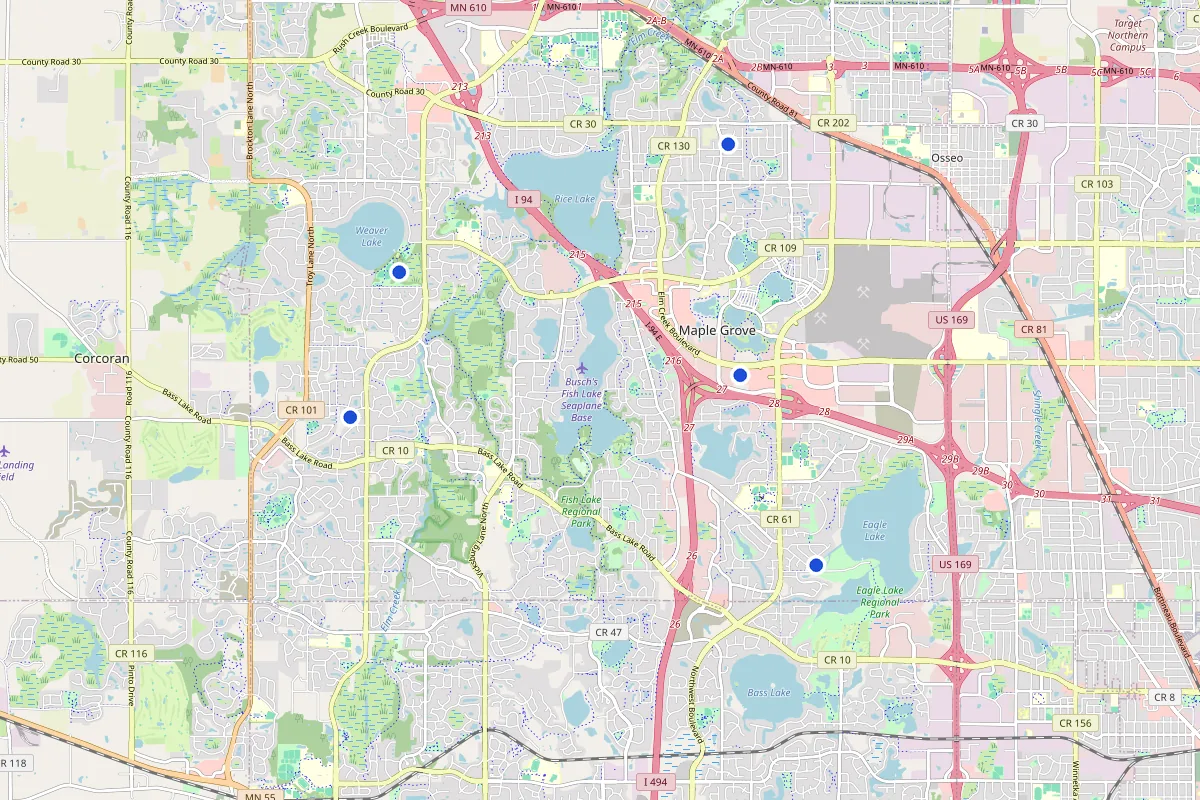
About the Weaver Lake corridor
The Weaver Lake corridor sits in the northeastern quarter of Maple Grove, anchored by Weaver Lake itself, a lake of about 149 acres (Metropolitan Council EIMS) ringed by mature oak and maple cover and an active improvement association. The corridor runs north of Bass Lake Road, east of Zachary Lane, and stretches up toward 101st Avenue, with the lake forming the visual and recreational center of the neighborhood. ZIP 55311 covers the entire corridor.
Housing is a mix of established 1980s and 1990s single-family-detached stock on the wooded interior streets and newer infill builds from the 2000s along the lake-adjacency premium parcels. Lot sizes here run noticeably larger than the Arbor Lakes new-build corridor. Quarter-acre and half-acre lots are common on the interior, and lakefront lots stretch well past that. Weaver Lake Elementary anchors the family-housing pocket on the south side, and the wooded subdivisions tucked between the lake and Bass Lake Road have the kind of backyard footprint that supports a real court build without crowding setbacks.
For backyard court projects, that’s the key story. The corridor’s larger lots mean a regulation 30 by 60 pickleball court fits without forcing the homeowner to choose between the court and the rest of the yard, and a 40 by 80 multi-sport pad still leaves room for the trees that give Weaver Lake its character. The lakefront subset adds a wrinkle: slope toward the shoreline matters for surface drainage and pad leveling, and it gets planned for during the site survey rather than discovered on dig day.
Named landmarks in the coverage area
- Weaver Lake itself, about 149 acres with a wooded shoreline and an active improvement association
- Weaver Lake Park
- Weaver Lake Elementary School, which anchors the family-housing pocket on the south side
- Bass Lake Road corridor, the southern edge of the neighborhood
- Zachary Lane North, the western edge running up toward 101st Avenue
- The wooded interior subdivisions between the lake and Bass Lake Road
If your address sits inside the area bounded roughly by these landmarks, you’re in our normal Weaver Lake service area.
Weaver Lake area: common questions
My backyard slopes down toward the lake. Can you still install a pickleball court? In most cases, yes. Lakefront slope is the site condition that most often shapes a Weaver Lake build. The court surface needs a level pad with proper drainage runoff away from the playing surface, which means a combination of regrading, retaining-wall work, or stepped foundation prep depending on the grade. The site survey measures the actual slope and the leveling work is quoted as a line item, so there are no surprises on dig day.
The build envelope I want is right at the tree line. Do you handle clearance? Yes, within reason. A court pad wants clearance from the root zone of a mature tree, both so the foundation sits on undisturbed base and so roots don’t heave the surface as they grow. How much clearance depends on the species and the trunk diameter, which is why it gets measured on your lot rather than assumed: the survey flags which trees are inside the build envelope, and the homeowner decides what to clear before mobilization. Arborist coordination is on you, but you get dimensioned drawings so a tree service can quote accurately.
Are there wetland or shoreline setbacks I need to think about near Weaver Lake? Possibly, and this is one to confirm with the City rather than take from us. Maple Grove does regulate building near its lakes: the City publishes a minimum setback from the ordinary high water mark for structures on lake parcels, and it asks that questions about a specific property go to its zoning enforcement staff with the address (City of Maple Grove — Zoning). Whether that setback reaches a court pad on your lot, and whether an adjacent wetland adds anything on top of it, are answers the City gives, and we don’t pull the permit for you. What the site survey does is map the build envelope against your parcel’s property lines, so you go into that conversation with a dimensioned plan instead of a guess.
Weaver Lake facts that bear on a backyard build
Weaver Lake is a public lake, and that brings the state shoreland rules into the picture. The Metropolitan Council’s monitoring record lists Weaver Lake at about 149 acres and about 17 meters deep at its deepest point, under the Elm Creek Watershed Management Commission (EIMS, Weaver Lake). Minnesota defines shoreland as land within 1,000 feet of the ordinary high water level of a public lake (Minn. R. 6120.2500, subp. 15), so a lakefront parcel and many of the streets behind it can fall inside that band.
The statewide minimums are the floor a city’s shoreland ordinance is written against. For structures on a sewered lot, they set a setback from the ordinary high water level of 50 feet on a general development lake and 75 feet on a recreational development lake, and they cap impervious surface on a shoreland lot at 25 percent of lot area (Minn. R. 6120.3300). Maple Grove’s own ordinance is what applies to your parcel and it can be stricter, so treat these as the starting point for the conversation with the City, not the answer.
The impervious cap is the number most likely to shape a court here. A regulation 30 by 60 ft pickleball slab is 1,800 sq ft, and a 40 by 80 ft multi-sport pad is 3,200 sq ft. Either one is added to the house, garage, driveway and patio already on the lot. On a lakefront lot inside the shoreland band, that total is what gets measured against the cap, so the existing hard surface is worth measuring along with the court footprint.
Sources read 2026-10-10.
Services covered in the Weaver Lake area
- Pickleball court installation: backyard pickleball court design and install: acrylic surfacing, fencing, nets, lighting.
- Multi-sport court installation: basketball, pickleball, tennis, volleyball, and futsal in a single court footprint.
- Putting green installation: synthetic multi-hole layouts with fringe collars, sand traps, and chipping zones.
- Backyard basketball court: residential half-court and full-court installs with concrete pad, acrylic surfacing, and in-ground hoops. Quoted on site survey.
- Batting cage installation: backyard netting structures with turf flooring and pitching mounds.