What putting green installation in Maple Grove, MN typically looks like
A backyard putting green is a long-tail homeowner project, the kind of build a serious golfer commits to once and then uses for the next 15–20 years. An artificial putting green is the same thing under a different name: the words artificial, synthetic, and turf all describe a stitched nylon or polypropylene putting surface laid over an engineered aggregate base, in place of live bentgrass. Most Maple Grove putting-green inquiries come from one of three profiles: a frequent-player homeowner who wants daily short-game practice without driving to a range, a family with a junior golfer entering competitive play, or an empty-nest household upgrading the backyard for entertaining and grandchildren.
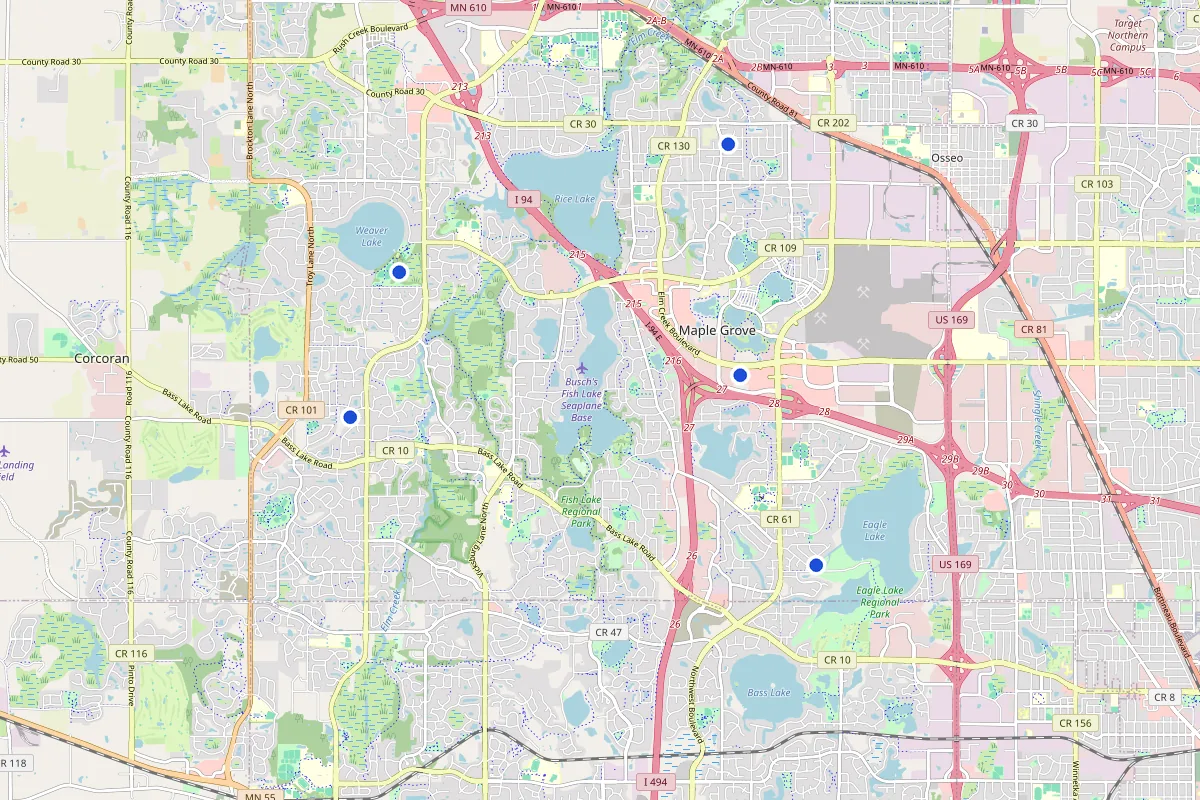
Synthetic-turf putting greens go in across Maple Grove ZIP codes 55311 and 55369, from the newer subdivisions east of I-94 around Arbor Lakes and Rush Creek, through the wooded lots near Weaver Lake and Eagle Lake, out to the established Elm Creek corridor. Most residential greens land between 250 and 1,500 square feet depending on lot size, hole count, and surrounding feature choices. A 500–800 sq ft single-hole green with a fringe collar fits comfortably in a typical Maple Grove backyard; a multi-hole layout with sand traps and chipping zones needs 1,000+ sq ft and either a deeper lot or a side-yard rework.
Putting greens are slightly more weather-tolerant than acrylic courts because synthetic turf doesn’t cure-set. There is no surface coating that needs sustained warm temperatures to harden. That said, the install window still runs April through October because the base prep (excavation, crushed stone compaction, edge bender installation) and turf adhesive both depend on workable ground and above-freezing temps.
Where these backyard golf green projects are installed
Wayfind Local is a directory. We connect homeowners with a local installer and we do not do the work ourselves.
The coverage this site is built for is Maple Grove, Minnesota and the adjacent northwest metro cities of Plymouth, Osseo, and Brooklyn Park, on the northwest side of the Minneapolis metro. Those are the cities listed in this site’s published service area. A property outside them depends on the installer’s own service radius, which they confirm before any site survey is scheduled.
What’s included
- Site survey with slope, drainage, and sun-exposure assessment
- Custom design covering hole layout, contour breaks, fringe and surround choices
- Base preparation: excavation, geotextile fabric, crushed-stone sub-base, laser-leveled compaction
- Turf system: tour-grade nylon putting surface installed with cut-in cup placement
- Fringe collars (longer-pile turf transition) on holes that call for them
- Sand traps (bunkers), chipping zones, or contour mounds per design
- Edging: composite bender board or aluminum trim to hold turf and infill
- Silica sand infill brushed in for true ball roll and pile stability
- Final walkthrough with ball-roll testing and stimpmeter check
How pricing works
What a backyard putting green costs in Maple Grove depends mostly on square footage, hole count, and the surround features you want. We are not the installer and we don’t set the price. The installer quotes your build in writing after the site survey.
What moves the number:
- Square footage. Turf area is the biggest single driver. A 250 sq ft chipping green is a much smaller job than a 1,200 sq ft multi-hole build.
- Hole count. Each additional cup means more contour planning, more fringe transitions, and more cut-in labor. A 1–3 hole green is the common backyard build; a 6–9 hole layout is a substantially larger job.
- Surrounds. Fringe collars, sand traps, and chipping zones add material and base-prep area.
- Turf grade. Tour-grade nylon putting surfaces cost more than polypropylene alternatives, covered below.
- Site conditions. Slope, drainage issues, or tree-root excavation can add base-prep hours. Flat sodded yards prep faster than reclaimed garden beds.
Every quote is written and given by the installer after an on-site survey. No round-number guesses over the phone.
Design choices: holes, breaks, surrounds
Putting-green design isn’t just turf and a cup. The layout choices drive how the green plays, how often it gets used, and how much it cost.
Hole count. A single-hole green is the most common residential build: one cup, room for a 6–10 foot putt from a few angles, and a small chipping area outside the fringe. Two- and three-hole greens suit homeowners who want more variety and break practice; six- to nine-hole layouts are for serious short-game work and family tournaments.
Slope and contour. A flat putting green plays repetitively and gets boring fast. Most quality designs include intentional contour breaks: a back-to-front fall, a side-tier shelf, or an off-center mound that simulates real-course green undulation. Contour work is built into the base-prep phase, not the turf phase.
Fringe collars. A fringe is the longer-pile turf ring around the putting surface that mimics the first-cut grass on a real course. Fringes let you practice chip-and-runs and lag putts that break across two pile heights. Some homeowners skip fringes to save cost; most quality builds include them.
Sand traps (bunkers). Adding a bunker turns a putting green into a full short-game practice area. Bunkers need their own excavation, drainage layer, and silica-sand fill. They’re an upgrade, not a default.
Chipping zones. A chipping zone is a turf area outside the fringe, usually a longer-pile mat, where you can hit 10–40 yard pitch and chip shots onto the green. Most chipping zones are 200–500 sq ft and add a meaningful upgrade for the cost.
Tour-grade nylon vs polypropylene turf
There are two main turf-fiber categories for artificial putting greens, and the choice drives both cost and how the green plays.
Tour-grade nylon. Higher pile density, truer ball roll, longer lifespan (typically 15–20 years), and better recovery from foot traffic. Used on most pro-installed greens and tournament-grade home builds. Higher upfront cost.
Polypropylene. Lower pile density, faster ball roll out of the box but tends to mat down faster, shorter lifespan (typically 8–12 years), lower cost. Suits lower-use installs and chipping-only greens.
For a homeowner planning daily practice, tour-grade nylon usually pays back over the green’s lifetime. For a chipping-only green or a low-use entertainment build, polypropylene can be the right call.
What a Minnesota winter means for a backyard golf green
Minnesota’s ground-frost cycle is why court builds and green builds sit on different calendars, and it is the part of the project most homeowners ask about first.
The 42-inch frost figure applies to footings, and an artificial putting green has none. The Minnesota State Building Code frost-depth figure used for footings in the Twin Cities metro is 42 inches, which is why anything carried on a post or a pier (a pergola, an in-ground basketball pole, a deck) has to be set below that line. A synthetic green carries no footings at all. It is a floating aggregate section: excavation, geotextile fabric, compacted crushed stone, turf, then infill. Nothing in that assembly has to reach frost depth.
What matters instead is drainage. A base built to drain rather than to hold water moves uniformly when the ground freezes, and it is differential heave, not frost itself, that damages a surface. This is the same reason the base-prep phase is where the money and the hours go on a Minnesota build, and why skipping compaction to save a day is the expensive decision.
The install season is set by workable ground, not by the turf. Excavation needs unfrozen ground and turf adhesive needs above-freezing temperatures, so Minnesota green builds run April through October. Winter is for surveys, HOA documentation, and holding a spot in the spring queue. Because there is no concrete pour and no acrylic cure, greens often fit into the shoulder weeks at either end of the season that a court build cannot use.
Maple Grove HOA considerations
Most Maple Grove subdivisions require architectural-review-board approval for any meaningful backyard improvement, putting greens included. The good news: putting greens are typically a simpler HOA approval than pickleball or sport courts because they generate almost no noise (no ball-on-paddle pop, no concrete construction phase, no fencing or lighting in most builds).
That said, HOAs will still want:
- Dimensioned site plan showing the green footprint and setbacks from property lines
- Material specs (turf type, infill, edging)
- Drainage plan if the green is large enough to alter runoff
- Photos or renderings if the subdivision is design-review-strict
Your board will tell you what its packet requires, and the installer who takes the job prepares what they need for it.
Process + lead time
- Site survey. The installer comes to the property, measures the proposed area, assesses slope and drainage, and walks through layout options with you.
- Written quote + design. The installer delivers a written flat-rate quote and a dimensioned design plan once the survey measurements are in.
- HOA review (if needed). Your board sets its own submission requirements, and the installer who takes the job prepares what they need for it. Review timelines vary by board.
- Build. Once HOA clears (or immediately if no HOA), the build can start. Time on site depends on the number of holes and features, so ask the installer for it with the quote.
Putting greens usually take less time than courts because there is no concrete pad to pour and cure.
How to check the builder, and the one code question worth asking
A putting green is a smaller job than a court, so the checks that matter are narrower. Two are worth doing before anything is signed, and both take minutes.
Ask for the residential building contractor license number, then look it up yourself. Minnesota Statutes section 326B.802 defines a residential building contractor as someone who contracts with an owner to build residential real estate by providing two or more of eight enumerated special skills, and excavation is one of them. A green build starts with excavation, so whether the license is legally required turns on how many of those eight a particular build touches. That is a fair question to put to a bidder rather than something to guess at. Licenses are searchable in seconds through the Minnesota Department of Labor and Industry at dli.mn.gov. Ask for the number, then check it there instead of accepting a photograph of a card. (Source: Minn. Stat. 326B.802, read 2026-09-11.)
Do not assume the tennis court carve-out covers a green. Maple Grove’s zoning code at section 36-788(d) excludes a short list of things from the definition of accessory buildings, and the list names unenclosed playhouses and gazebos, uncovered swimming pools, detached decks or patios, and tennis courts. A putting green is not on it. That is not the same as saying a green is an accessory building. It means the code does not say, and the answer for your parcel comes from Maple Grove Community Development at 763-494-6040. A ground-level synthetic surface and a build that adds a bunker with its own excavation or a retaining edge are not obviously the same question, so ask before the design is fixed rather than after. (Source: Maple Grove Code of Ordinances, Chapter 36 Zoning, section 36-788, read 2026-09-11.)
And one rule the city will not settle for you. The Building Department’s Fences handout states plainly that protective covenants on a lot might have different location and design requirements, that covenants are not enforced by the City of Maple Grove, and that you should contact your association about rules specific to your property. A green can satisfy every city rule and still need written approval from an architectural review committee first, which is why the review calendar in the section above is worth asking about early.
Sources: Minn. Stat. 326B.802 and the Minnesota Department of Labor and Industry license lookup; Maple Grove Code of Ordinances, Chapter 36 Zoning; City of Maple Grove Building Department “Fences” handout, rev. 4/14/2021.
Common questions
How long does synthetic putting-green turf last? Tour-grade nylon turf typically lasts 15–20 years with normal residential use; polypropylene runs 8–12 years. The base prep and edging, if done correctly, outlast the turf, so eventual replacement is a turf-only project, not a full rebuild.
Is an artificial putting green the same as a synthetic one? Yes. Artificial, synthetic, and turf green all describe the same product: a stitched nylon or polypropylene putting surface over a compacted aggregate base, with silica sand brushed in for ball roll. Installers in Minnesota use the terms interchangeably, so a quote for an artificial green and a quote for a synthetic green are quoting the same build.
How much maintenance does a synthetic putting green need? Far less than a real green. Plan on brushing the surface every 2–4 weeks with a turf brush to keep the pile standing, topping off silica-sand infill annually, blowing leaves and debris seasonally, and occasionally rinsing for pollen or tree-sap residue. No mowing, no watering, no chemical treatments.
How many holes should my green have? Depends on use case and lot size. A single hole suits most casual-practice homeowners and fits comfortably in 250–600 sq ft. Two to three holes adds variety and break practice. Six to nine holes is for serious practice and needs 1,200+ sq ft.
Do sand traps need ongoing upkeep? Yes. Bunker sand needs to be raked level after use, replenished every 1–3 years depending on use, and occasionally cleaned of leaves and debris. The bunker liner under the sand should last 15+ years.
How does a synthetic green perform through Minnesota winters? Synthetic turf handles Minnesota winters well. Snow can be left to melt naturally, or shoveled with a plastic (not metal) shovel if you want winter access. The turf and infill don’t freeze-damage. Ball roll returns to normal once the surface dries in spring.
Does a putting green need footings below the Minnesota frost line? No. The 42-inch frost-depth figure in the Minnesota State Building Code governs footings, and a turf green has none. It is a compacted aggregate section that moves with the ground as one piece, which is why base drainage and compaction matter more on a Minnesota green than depth does.
How much does a backyard putting green cost in Maple Grove, MN? The section above covers each cost driver; every quote is written by the installer after an on-site survey.
Do you build backyard golf greens and chipping greens near Maple Grove’s golf courses? We do not build anything ourselves; this site connects you with a local installer who builds them. A backyard green suits daily short-game practice without booking a tee time. A backyard golf green with a fringe collar and a dedicated chipping zone gives you putting plus 10–40-yard pitch-and-chip practice in the yard, on the same April-through-October install calendar as the court builds.
Maple Grove neighborhoods covered
Backyard putting green projects are covered across every Maple Grove neighborhood and ZIP code:
- Arbor Lakes: Main Street district, The Shoppes and The Fountains residential corridor (55369 / 55311)
- Weaver Lake: wooded subdivisions north of Bass Lake Road, Weaver Lake Park area (55311)
- Eagle Lake: Eagle Lake Regional Park corridor along 93rd Avenue (55369)
- Rush Creek: newer subdivisions on the west side (55311)
- Elm Creek: established corridors along Elm Creek Boulevard (55369 / 55311)
ZIP coverage: 55311 and 55369, Maple Grove neighborhoods, install-season scheduling April through October.
Related services
- Pickleball court installation in Maple Grove, MN, often paired with putting greens for full-backyard recreation builds
- Multi-sport court installation in Maple Grove, MN, for households wanting a combined court-plus-green build