Backyard basketball courts in Maple Grove, MN come in three broad shapes — compact half-courts, 50x30 ft half-courts with a full three-point arc, and scaled residential full-courts — for households across Maple Grove and the adjacent northwest Twin Cities suburbs. If you’re past the “should we?” stage and ready to put a real court in the yard, this page covers what a Maple Grove build involves: layout and sizing, surface choice, the HOA architectural-review package, in-ground hoop install below the frost line, and the April-through-October Minnesota install season.
What a backyard basketball court in Maple Grove, MN typically looks like
Most Maple Grove backyard basketball projects fall into one of three shapes: a half-court for 1-on-1 and 3-on-3 play (the common pick), a scaled-down full-court for 5-on-5 in the bigger-lot subdivisions, or a key-only “shoot-around” pad anchored by a single in-ground hoop. Half-court footprints start around 30x30 ft and stretch to 50x30 ft, the size that holds a full three-point arc. A regulation full court is 94x50 ft; on residential lots the more common build is a scaled 60x30 ft version that plays a real 5-on-5 game without consuming the whole backyard.
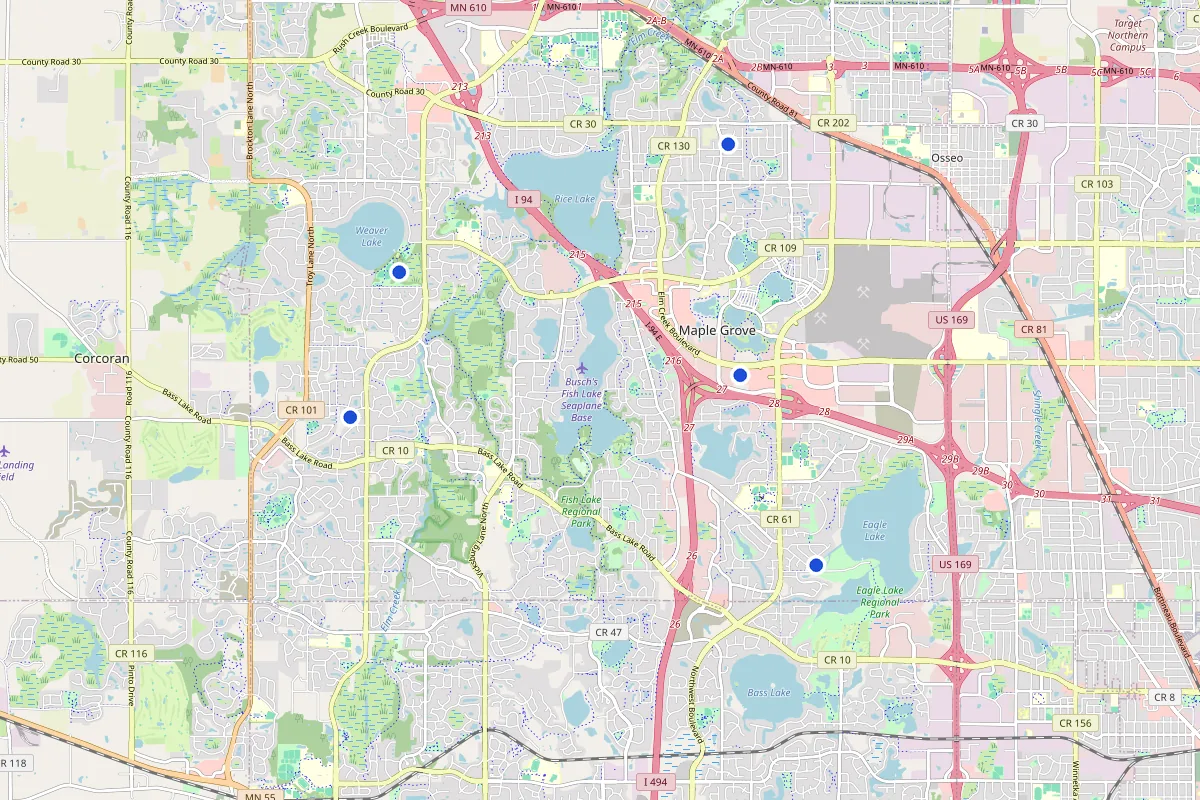
This site covers both Maple Grove ZIPs, 55311 and 55369, including Arbor Lakes, Rush Creek, Weaver Lake, Eagle Lake and the corridors off Elm Creek Boulevard. If your subdivision has an HOA, read its architectural-review rules before you settle on a court size.
Half-court vs full-court usually comes down to usable lot dimensions after setbacks, household play pattern, and budget — the jump to full-court is the single biggest cost lever on the project.
Maple Grove’s basketball scene
Maple Grove backs basketball at the city level. Central Park keeps an outdoor basketball-and-pickleball sport court alongside its splash pad and playground, and Gleason Fields — the city’s lit, turf sports complex — adds a full basketball court beside its four ball fields, tennis court, and pickleball courts (per the City of Maple Grove parks pages). Those public courts fill up — which is exactly why so many Maple Grove households end up wanting one at home: no waiting for an open hoop, no sharing the court, and lights for evening play.
A backyard basketball court in Maple Grove is the at-home version of a game the whole city already plays. The sizing, surface, HOA, and seasonal-timing decisions below are what turn that into a real build.
What’s included
- On-site survey: lot dimensions, slope, drainage, setback check, sun and tree-shade mapping
- Dimensioned layout plan with court orientation
- HOA architectural-review package: drawings, materials spec, color samples
- Sub-base prep: excavation, geotextile fabric, compacted aggregate base
- Surface system install: poured concrete + acrylic OR modular sport-tile
- In-ground hoop install: pole anchored below frost line, backboard, rim
- Optional LED lighting on perimeter poles
- Court-line painting: free-throw, three-point arc, key, sideline / baseline
- Final walkthrough, surface-care instructions, written warranty
How pricing works
Maple Grove residential basketball projects split into two main types — a half-court and a full-court — plus add-ons like an in-ground hoop and perimeter lighting. We are not the installer and we don’t set the price; the installer quotes your build in writing after the site survey.
What moves the number: surface system (acrylic vs modular tile), sub-base condition (slope, clay, drainage), site access for excavation and concrete equipment, and hoop tier (residential vs commercial-grade glass-backboard).
Siting note: Maple Grove site conditions — lot slope, clay sub-base, excavation access — and the April–October install window are what shape a given project, and they are the first things the installer looks at on the survey. The same base-prep economics apply to a multi-sport court, so if you are weighing basketball against a combination surface, it is worth pricing both in the same conversation.
Ask for the quote in writing, after the site survey rather than before it, and ask what would change the number once work is under way. A written scope you can hold the installer to is the thing worth insisting on.
Half-court vs full-court vs key-only sizing
| Layout | Footprint | What it supports |
|---|---|---|
| Key-only / shoot-around | ~20x20 ft + 1 hoop | Free throws, layup drills, casual shoot-around |
| Half-court (compact) | 30x30 ft | 1-on-1, 2-on-2; short three-point arc |
| Half-court (full arc) | 50x30 ft | 3-on-3 to 4-on-4, full three-point arc, regulation-size key |
| Full-court (residential) | 60x30 ft | Scaled 5-on-5 full game; fits most large lots after setback |
| Full-court (regulation) | 94x50 ft | Full 5-on-5; requires a very large lot, uncommon in residential Maple Grove |
The 50x30 ft half-court is the sweet spot for most households — plays a real 3-on-3, holds a full three-point arc, and fits most Maple Grove lots after setback math.
Surface system: concrete + acrylic vs modular tile
Two paths, same trade-off framing as the multi-sport-court page:
- Poured concrete + acrylic color coat. Lower up-front cost. Hard, fast surface. MN freeze-thaw cycles age acrylic faster than tile; repairs are spot-patch and recoat.
- Modular sport-tile. Higher up-front cost. Tile flexes under load — easier on joints, plays faster in cold weather, and individual tiles can be lifted and replaced without recoating the whole court.
Spring-to-fall play for seasonal use — concrete + acrylic. All-season play, heavy use, or long-term repairability priority — modular tile.
Maple Grove HOA + setback considerations
Most Maple Grove subdivisions require architectural-review-board approval for backyard courts. The city zoning code also sets side-yard and rear-yard setbacks, and whether they reach a concrete pad and its perimeter fencing on your lot is a question for the City — we don’t pull the permit for you. Basketball typically carries less noise-litigation risk than pickleball (ball-on-pad is lower-frequency than ball-on-paddle), but the architectural-review process is the same: dimensioned drawings, materials spec, surface color samples, and any lighting plan.
Your board sets its own submission requirements, and the installer who takes the job prepares what they need for it. Most reviews clear in two to four weeks, and build scheduling follows written approval.
Process + lead time
- Site survey. Lot dimensions, slope, drainage, setback math, access check. The installer who takes the job puts its written quote together once those measurements are in.
- HOA review. Your board sets its own submission requirements; the installer who takes the job prepares what they need for it, and you submit it.
- Schedule break-ground. Once HOA approval clears, the build is scheduled into the April–October install season (frost depth and acrylic curing temperatures gate winter work in MN).
- Build. Excavation and sub-base run a few days; concrete pour and cure adds about a week; surface install follows; hoop and lighting close out.
- Final walkthrough. Surface-care instructions, any warranty the installer offers, and a play-test at handover.
Total call-to-completion is typically two to four months, driven by HOA review and the seasonal install window.
Frost depth and the impervious surface cap in Maple Grove
Two published rules put numbers on a backyard basketball build, one for the hoop and one for the slab. Both are worth reading before the survey.
The state frost figure for Hennepin County is 3 1/2 feet. Minnesota Rules part 1303.1600 sets the minimum footing depth for frost protection at five feet in Zone I and 3-1/2 feet in Zone II, and Hennepin County is in Zone II. The same rule allows less depth when an engineer competent in soil mechanics presents supporting evidence. It is written for building footings, and the rule does not say whether a hoop pole is one. What it gives you is a reference number: this page says the pole is anchored below the frost line, so ask each bidder how deep they set the anchor and what that depth is based on. (Source: Minnesota Rules part 1303.1600, read 2026-10-07.)
A concrete court counts toward a 40 percent impervious surface cap. Maple Grove City Code section 36-787 sets the maximum impervious surface for a lot in the R-1, R-2 and R-3 residential districts at 40 percent. The sizes on this page work out to 900 sq ft for a 30x30 compact half-court, 1,500 sq ft for a 50x30 full-arc half-court and 1,800 sq ft for a 60x30 full-court, and each is added to the house, the garage, the driveway and any patio already on the lot. A hoop set at the edge of an existing driveway adds almost nothing to that total, because the driveway is already counted, which is one reason a standalone hoop is the lightest build on this page. If a court would take the lot over the cap, the answer is a design change rather than a hope, and a bidder who measures the lot against the cap before quoting is doing the useful part of the survey. (Source: Maple Grove Code of Ordinances, Chapter 36 Zoning, section 36-787, read 2026-09-11.)
Sources: Minnesota Rules part 1303.1600 and the Maple Grove Code of Ordinances, Chapter 36 Zoning. How each applies to your specific parcel is a question for Maple Grove Community Development at 763-494-6040, and that call is yours to make rather than ours.
Common questions
How much does a residential in-ground hoop cost installed? It depends on the hoop tier and the groundwork. A standard residential system — pole anchor set below the frost line, backboard, rim, adjustment hardware — is a straightforward install; commercial-grade glass-backboard systems with a hydraulic lift are a bigger job. The installer quotes it in writing; we don’t set their pricing.
Do I need lighting? Not required, but most households who play evenings end up adding it.
Can I add pickleball lines later? Yes — adding pickleball, futsal, or volleyball lines is a standard add-on. Cleanest on poured-concrete + acrylic (lines paint directly on the surface).
Is modular tile worth the premium? Heavy year-round use, joint-impact concerns, or households wanting tile-by-tile field repairability — tile pays off. Spring-to-fall casual play for seasonal use — concrete + acrylic is usually the right call.
Will my neighbors complain about noise? Basketball is generally lower-conflict than pickleball — ball-on-pad is lower-frequency than ball-on-paddle. Most common trigger is late-evening play with lighting; HOA review boards often ask for a lighting curfew, and yours will tell you what hour it wants.
How much does a backyard basketball court cost in Maple Grove, MN? The section above details what moves the number; every quote is written by the installer after the site survey.
Do you install in-ground basketball hoops on their own in Maple Grove? Yes — in-ground basketball hoops are commonly installed as a standalone project for Maple Grove homeowners who already have a driveway or pad, not only as part of a full court build. The pole is anchored below the Minnesota frost line so winter frost heave won’t shift it over the seasons.
Do you build backyard basketball courts elsewhere in Minnesota? Our core service area is Maple Grove and the adjacent northwest Twin Cities suburbs — Plymouth, Brooklyn Park, and Osseo. For larger full-court builds the coverage area stretches farther into the Minnesota metro; say where you are when you get in touch, because whether an address is in range is the installer’s answer and it is worth having before a survey is scheduled before a survey is scheduled.
Maple Grove neighborhoods covered
- Arbor Lakes — new-build subdivisions east of I-94, highest concentration of half-court and full-court installs
- Weaver Lake — wooded lots north of Bass Lake Road
- Eagle Lake — residential corridor along 93rd Avenue near Eagle Lake Regional Park
- Rush Creek — newer corridor in 55311
- Elm Creek — established homes off Elm Creek Boulevard
ZIP coverage: 55311 and 55369 — Maple Grove neighborhoods.
Related services
- Multi-sport court installation in Maple Grove, MN — basketball plus pickleball, tennis, futsal, or volleyball on one pad
- Pickleball court installation in Maple Grove, MN — dedicated pickleball builds, with layout and sound-buffer planning