Volleyball court installation in Maple Grove, MN comes in two very different builds: a sand court, which is mostly excavation, drainage and a lot of the right sand, and a hard court, which is a slab with volleyball lines and a pair of net sleeves. This page covers both for homeowners across Maple Grove and the northwest Twin Cities metro in Minnesota: how much yard each one takes, what goes under the sand, how net posts are set, and the questions worth asking a builder before anyone digs.
One thing up front. This site is run by Wayfind Local Group, and we do not build courts. We connect Maple Grove homeowners with a local court builder, and the builder designs, prices and builds the job. See our vendor disclosure for how that works and how we are paid.
Sand court or hard court: the first decision
Most people searching for a volleyball court in Minnesota picture one of two things, and they are not the same project.
- A sand court is the beach game. It needs a deep, soft, fast-draining bed of sand, a border to hold it, and freestanding net posts. There is no slab and no surface coating. Most of the work is below the sand, where you never see it.
- A hard-court volleyball setup is the indoor game played outdoors on a court surface. It is usually one sport on a multi-sport court: volleyball lines painted alongside pickleball or basketball, and a pair of net sleeves set into the slab so the volleyball net goes up and comes down.
If your household already wants a pickleball or basketball surface, adding volleyball to that slab is the smaller job and the multi-sport page is the better starting point. If what you want is a sand court, the rest of this page is about that build, because it is the one people underestimate.
How much yard a sand court takes
The playing court is smaller than the area you build. Volleyball Canada’s construction guide, “How to Build a Beach Court,” gives the court itself as 8 m by 16 m for doubles (about 26 by 52 feet) and 9 m by 18 m for triples, fours and sixes (about 30 by 59 feet). It then says the area excavated and filled with sand should be at least 14 m by 24 m (about 46 by 79 feet), so there is a sand perimeter around the lines. (Source: Volleyball Canada, Ed Drakich, “How to Build a Beach Court,” read 2026-10-20.)
The same guide asks for:
- Clear space of 3 to 4 m on all sides of the court, about 10 to 13 feet, with anything that could be a hazard padded.
- At least 7 m of clearance overhead, about 23 feet, which in a Maple Grove backyard usually means looking up at tree limbs and overhead lines before looking down at the lawn.
- A site free of large rooted or overhanging trees around the edge of the court.
- A north to south orientation where possible, so neither side serves into a rising or setting sun.
A full 46 by 79 foot sand bed is a large share of a typical suburban lot. Many backyard courts are built smaller than that to fit the yard. That is a reasonable trade for recreational play, and it is a decision to make with the builder looking at your property rather than from a diagram.
What goes under the sand
This is the part that decides whether a sand court plays well in July or sits as a wet, packed box after every rain.
Sand depth. The Volleyball Canada guide calls for a sand depth of 30 to 40 cm, about 12 to 16 inches, and more depth where a gravel layer or drainage pipe is needed under the sand. For top-level competition the bar is higher still: the FIVB rules, as summarized in a Hong Kong Education Bureau infographic on the 2025 to 2028 beach rules, require sand at least 40 cm deep, made of fine, loosely compacted grains. (Source: Education Bureau of Hong Kong, “Beach Volleyball” infographic citing the FIVB Official Beach Volleyball Rules 2025 to 2028, read 2026-10-20.)
Drainage. The guide recommends excavating an additional 30 cm, about 12 inches, below the sand depth so drainage pipe can be laid on a slant, with the outlet leading away from the court at its lowest point. Depending on the soil, it suggests a layer of gravel over the pipe and a semi-permeable cover, such as landscaping mesh, over the gravel so the sand does not wash down into it. It notes that on soil that already drains well and has no rocks, the pipe system can sometimes be skipped, but it still recommends the liner between the sand and the soil.
What that means in Maple Grove. Drainage is a site question, not a catalog choice. Whether your lot needs pipe, how deep the gravel goes and where the water is sent are things a builder answers by looking at your soil and your grade. Ask where the outlet will discharge, because water sent toward a neighbor’s yard or a foundation is a problem you would rather solve on paper.
The sand itself
The guide calls sand selection probably the most important factor in court construction, and it gives a specific list:
- Washed. Double washed and free of silt and clay, so it does not compact.
- Particle size between 0.5 and 1 mm, for drainage and for safety on a dive.
- Sub-angular grains, which resist compaction and help drainage.
- Tan in color, which absorbs less heat and throws less glare.
- Granite based rather than limestone, so it stays stable through the weather.
It also gives the quantity for a full-size bed: 160 to 200 tonnes of sand per court. That number explains a lot about the project. It is many truckloads, it needs a route into your backyard that a loaded truck or a loader can use, and that route crosses whatever is between the street and the court. Ask the builder how the sand gets to the back of your lot and what the access path will look like when they are done.
The FIVB summary adds one more requirement worth keeping for a backyard: the sand should be sifted to an acceptable size and free of stones and dangerous particles. On a game played barefoot and on the dive, that matters more than the color.
Net posts, a border, and a Minnesota winter
Posts. For permanent standards, the Volleyball Canada guide describes galvanized, thick-walled steel pipe of 4 to 5 inches in diameter or 6 inch pressure treated wood, each 4 m long, with 3 m above the sand and 1 m set into a concrete footing. It places the posts 10.0 to 10.5 m apart, about 33 to 34 feet, because the net is 9.5 m wide and needs room for its adjusting cables. Permanent posts should be freestanding, without guy wires, and padded.
Net height. The same guide gives 2.43 m for men’s and co-ed play and 2.24 m for women’s play. A post that only reaches one height is a post that fits one group of players, so if the household spans ages, ask for a post and net system that adjusts.
Frost. That 1 m footing is about 39 inches. Minnesota’s building code sets the minimum footing depth for frost protection at 3 1/2 feet, 42 inches, in Zone II, the zone Hennepin County is in. (Source: Minnesota Rules, part 1303.1600, read 2026-10-20 at revisor.mn.gov.) That rule is written for building footings, not for volleyball posts, so it is not a requirement for your court. It is a useful reference for how deep frost reaches here, and it is a fair question to put to any builder: how deep will the post footings go, and what keeps a post from moving after a Maple Grove winter?
Border and boundary lines. The guide recommends a border around the whole sand bed to contain the sand, soft and contoured so a player who lands on it is not hurt. Lines on a sand court are rope or ribbon, about 5 cm wide, held at the corners by buried anchors with a bungee so a caught foot pulls the line rather than tripping the player.
Volleyball in Maple Grove already
The game is not new here. Weaver Lake Park, the city park on Weaver Lake, has sand volleyball courts beside its public beach, and a local family guide tells visitors to pack a volleyball with their beach gear. (Source: Family Fun Twin Cities, “Weaver Lake Park,” read 2026-10-20.) A backyard court is the same game on your own schedule, without carrying the ball and the net to the lake.
What to ask before you hire a builder
A sand court is a project where the questions matter more than the brochure. Before you agree to a build, it is worth having clear written answers to these:
- Have you built a sand volleyball court before, and can I see one? A sand court is closer to excavation and drainage work than to pouring and coating a hard court, so a builder’s hard-court experience does not answer this question. Ask directly.
- What size will the playing court and the sand bed be, and where exactly on my lot?
- How deep is the sand, what is under it, and where does the water go?
- What sand are you using, and where is it from? Ask whether it is washed and what its grain size is.
- How do the trucks and the sand get to the back of my yard, and what will the access path look like afterward?
- How deep are the post footings, and do the posts adjust for net height?
- What does my HOA need to see, and who prepares it? If your subdivision has an architectural review board, ask it what a submission needs before the layout is final, and ask the builder who prepares it.
- What does the court need each spring? Sand settles, blows and gets tracked out. Ask what topping up and raking the builder expects, and how often.
On city rules, the multi-sport court page covers the Maple Grove code sections that size a large backyard court. Whether a sand court counts toward your lot’s impervious surface limit, and where on the parcel it may sit, are questions for Maple Grove Community Development, and that call is yours to make rather than ours.
Common questions
How big is a backyard volleyball court? A doubles sand court is 8 m by 16 m, about 26 by 52 feet. The six-player court is 9 m by 18 m, about 30 by 59 feet. Volleyball Canada recommends a sand area of at least 14 m by 24 m around either one. Many backyard courts are built smaller than that to fit the lot.
How deep should the sand be on a sand volleyball court? Volleyball Canada’s guide gives 30 to 40 cm, about 12 to 16 inches, with more depth if a gravel layer or drainage pipe goes underneath. FIVB competition courts require at least 40 cm.
Do I need drainage under a sand volleyball court in Minnesota? It depends on your soil. The guide recommends drainage pipe in an extra 30 cm of excavation below the sand, and says a site with soil that already drains well and has no rocks can sometimes do without the pipe. It still recommends a liner between the sand and the soil. The builder who looks at your lot is the one who can answer this for your yard.
Can I play volleyball on a pickleball or basketball court? Yes. Volleyball lines can be painted on a hard court alongside other sports, with net sleeves set into the slab so the net comes down when the court is used for something else. Our multi-sport court page covers that build.
Do you build commercial volleyball courts? We do not build courts at all. We connect people with a local court builder. This page is written for backyard and private-property courts. If you are planning for a club, a school or a business, say so when you reach out, and the builder will tell you whether that scale of project is one they take on.
How do I get a volleyball court quote in Maple Grove? Use the form on this page. We pass your request to a local court builder, who looks at your yard and quotes the job in writing. We do not set the price.
Maple Grove neighborhoods covered
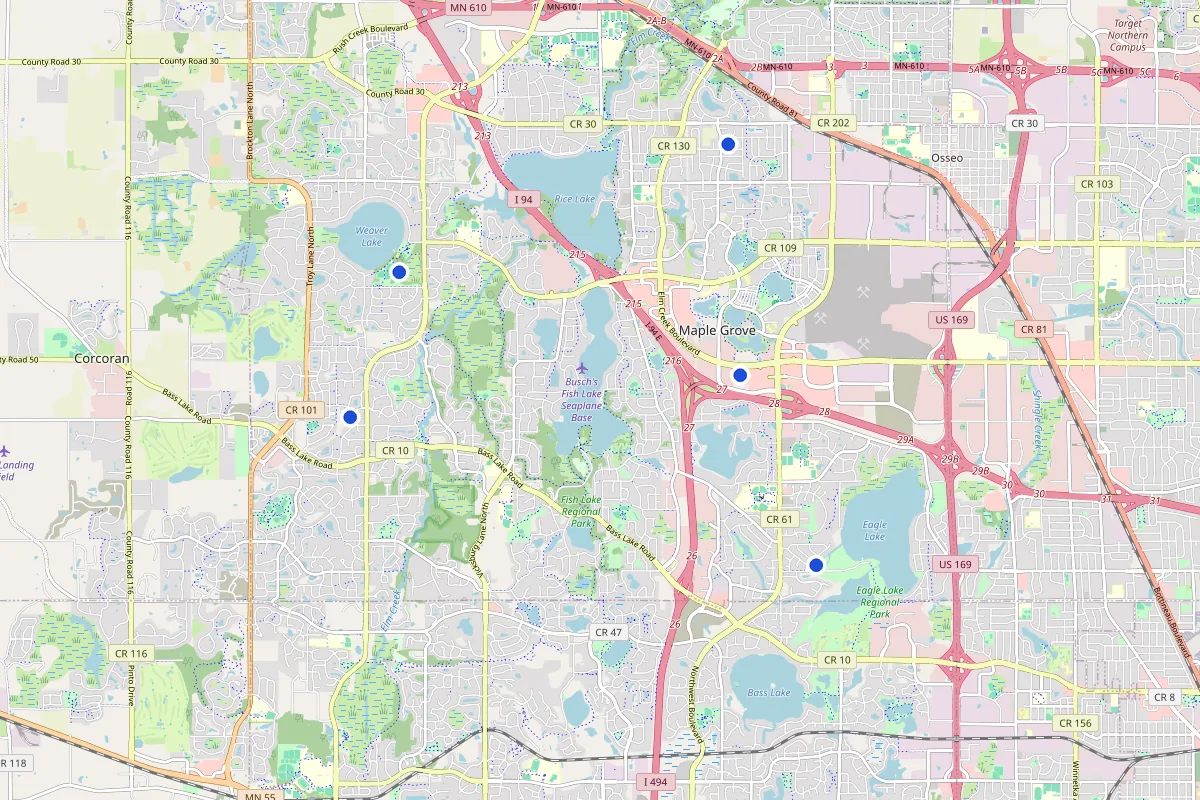
Volleyball court requests are covered across Maple Grove ZIPs 55311 and 55369, including Arbor Lakes, Weaver Lake, Eagle Lake, Rush Creek and Elm Creek, and into the adjacent northwest metro suburbs of Plymouth, Brooklyn Park and Osseo for the right project.
Related services
- Multi-sport court installation in Maple Grove, MN, for volleyball lines on a hard court shared with other sports
- Pickleball court installation in Maple Grove, MN, when the paddle game is the main use
- What a backyard court costs in Maple Grove, MN, for what moves the price of a court build and how to compare two written quotes
Sources: Volleyball Canada, “How to Build a Beach Court” (Ed Drakich), read 2026-10-20. Education Bureau of Hong Kong, Beach Volleyball infographic, citing the FIVB Official Beach Volleyball Rules 2025 to 2028, read 2026-10-20. Minnesota Rules, part 1303.1600, Footing Depth for Frost Protection, read 2026-10-20. Family Fun Twin Cities, “Weaver Lake Park”, read 2026-10-20.